
Forward Contract Pricing – Calculating Forward Exchange Rates
The pricing of a Currency Forward Contract is a straightforward concept based on three factors:
- The current spot rate for the currency pair;
- The interest rate differential between the two currencies involved in the trade (e.g., the difference in the base rate in the UK & EU for GBPEUR trades);
- The time until the contract matures.
If the pricing of a Currency Forward Contract deviated from these principles, it would create an arbitrage opportunity. Investors could exploit the difference in interest rates to trade Forward Contracts and make a profit.
No Judgement in Forward Exchange Rates
It is tempting to assume that a forward exchange rate carries some kind of implicit forecast regarding potential currency movements. However, this is not the case. The forward rate is a purely mechanical function based on:
- Interest rate differentials;
- The time until the contract matures;
- The current spot rate.
Even if a currency appears substantially out of line with fundamentals, the forward rate does not incorporate any assumptions about corrections, forecasts, or mean reversion. This contrasts with the options market, where there is always an implied judgment of future trends reflected in demand and supply.
When to Use Currency Forwards
The use of a Forward Contract is particularly beneficial during periods of transaction uncertainty surrounding major economic or political events. A clear example is the 2016 UK referendum on EU membership. If a UK buyer of overseas property signed a contract just before the referendum, but the funds were not deliverable until after, there was a substantial currency risk involved.
Predicting Exchange Rate Movements
Similarly, there is a strong case for taking out a Currency Forward Contract if there is an income flow in an overseas currency and sterling is historically weak. For example, any sterling move towards parity against the dollar or Euro would be extremely attractive based on rates that have prevailed over the past 30 years.
It’s important to note, however, that rates could move for or against you after a Forward Contract has been booked—FX rates are constantly moving every second of the day.
To summarise, you should consider an FX risk assessment prior to booking an FX Forward Contract.
Forward Contracts, also known as Currency Forward Contracts or FX Forwards, are rising in popularity due to an uptick in currency volatility and the ease with which they can be accessed. This simple hedging tool, once reserved for multinational corporations, is now readily available for everyone, including individuals and SMEs.
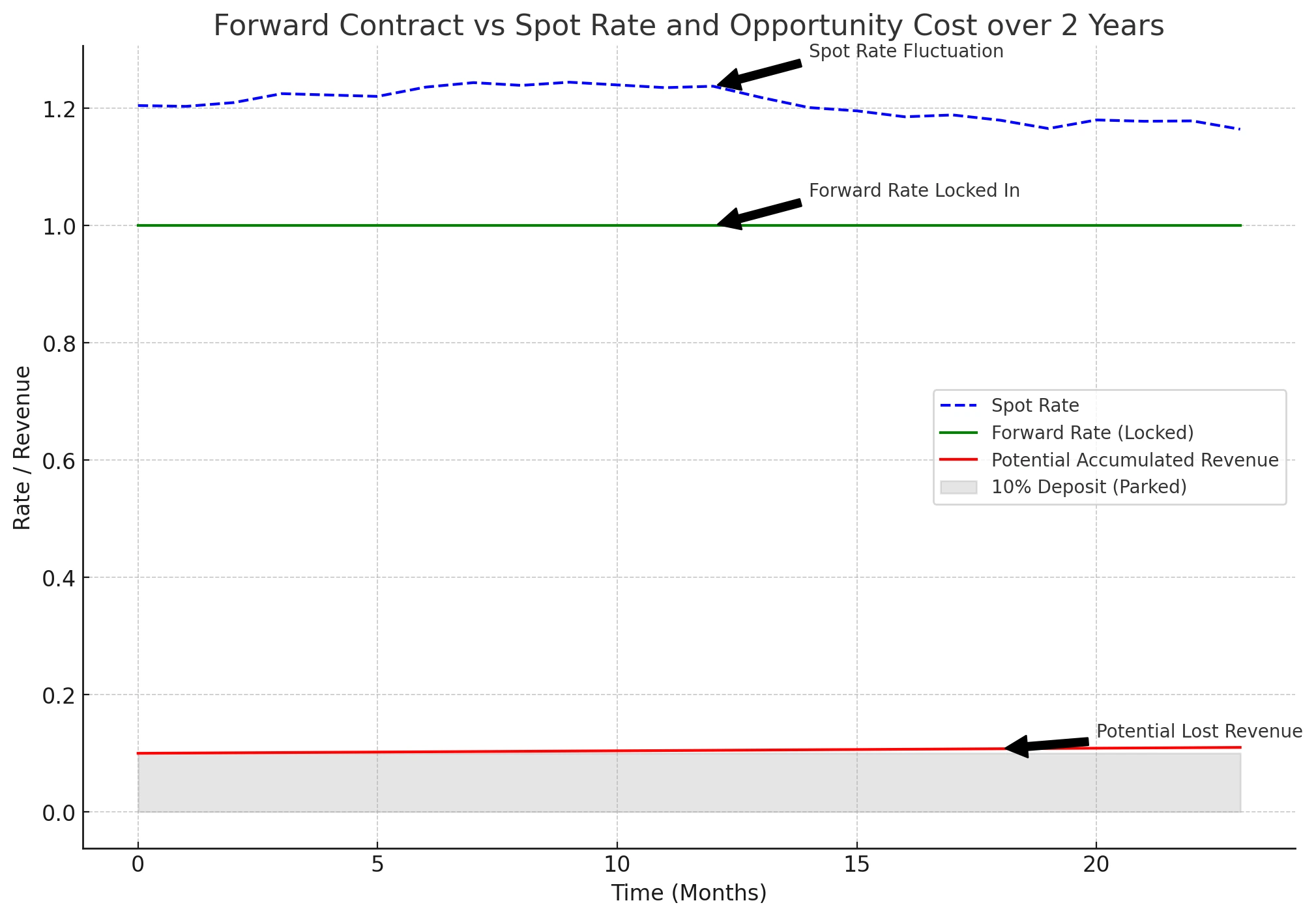
Booking a Forward Contract enables you to lock in today’s exchange rate for the future and mitigate currency volatility, making it a useful tool for individuals or businesses attempting to manage their FX risk exposure.
Everyone Loves Forwards
A Forward Contract is a straightforward tool, unlike some other currency hedging tools. It locks in today’s FX price for the future, with no “ifs and buts”. However, there are still important questions that must be addressed before entering into a Currency Forward Contract agreement.
Before We Begin: What Are Forwards
A Forward Contract is a financial arrangement that allows two parties to buy and sell an asset at a fixed price in the future. A Forward Currency Contract is a foreign exchange instrument that allows two parties to buy or sell a currency pair at a guaranteed exchange rate in the future. The FX rate you receive with a Currency Forward is the prevailing exchange rate at the time of entering into the agreement.
The rate is often advertised as the ‘current exchange rate,’ but it will differ slightly due to what’s known as ‘interest rate differentials’—more on this later.
For example, if you are booking a GBPEUR Forward Contract for a period of 12 months, it means that 12 months from now you have committed to buying a certain amount of euros at the GBPEUR rate as it is today. How the currency pair moves during this time is irrelevant to the rate you achieve.
Is a Forward Contract the Same as an FX Future?
Forward Contracts and Currency Futures are both derivatives that offset the effect of currency movements, but their mechanisms are different. A Forward Contract is an over-the-counter arrangement made with a financial institution and is only settled upon maturity (as dictated in the contract), while Futures are publicly traded on exchanges and settled on a daily basis with set maturity dates.
In other words, Forwards are more of a bespoke tool—you buy a Forward Contract matching your specific needs, but also commit to it without any exit options, whereas a Future can always be sold.
Like Currency Forwards, Forex Futures are just one type of future contract. You will also find commodity futures (such as crude oil, gas, and wheat), stock index futures, and bond futures (e.g., UK/US treasury bonds).
Are Forward Contracts Limited to 12 Months?
Most banks and providers offer Forward Contracts up to 12 months in the future, but some established brokers like moneycorp can offer longer Forwards of up to 24 months and even longer. Since, as mentioned above, a Currency Forward is a bespoke contract negotiated between two parties (the issuer and the entity buying the Forward), it all depends on who these parties are.
The maximum length of time you can book a forward contract?
From our research, the boutique currency brokerage known as Fiscal FX is prepared to offer the longest forward contracts—all the way through to a whopping 5 years.
Do I Need to Pay a Deposit for a Forward, and Why?
When you book an FX Forward Contract, you are generally required to put down a deposit. The reason is that specialists and banks need to protect themselves from a default or cancellation of the contract.
The deposit is normally 10% of the value of the agreement. If currency movements mean the deposit becomes substantially less than 10%, the provider may ask you to top it up. The reason for this is that if you cancel the contract, the provider is then required to purchase the original selling currency at the prevailing exchange rate on the date you cancel the agreement.
Consider the deposit the same as you would paying a deposit on a sofa—only the remaining 90% is then due when the Forward Contract matures.
In some cases, specialists like moneycorp, which are very seasoned in this business, will remove the need for a deposit. Though this is typically only for business clients.
How to Book a Forward Contract
Whether you are a corporation, SME, sole trader, or an individual who doesn’t own a business at all (but has FX requirements such as proceeds from a sale of property abroad), and annual amounts surpass £10,000, you are eligible to book a Forward with any of the following providers:


 TorFX: Friendly, Experienced Team with Business Expertise
 - Personal, Friendly Service
- High TrustPilot Rating
- Regular Market Updates

 Xe: Advanced Business APIs, Best Streamlined Payments
 - Fast and Effective Sign Up Process
- Superb Functionality All Around - Intuitive Online Platform, Smooth App, and Personalised Touch with Dedicated Dealers Above $50,000 Volume
- Global Company with Strong Presence in the UK
 Key Currency: The Best Botique Business FX Broker
 - Fastest Growing UK Currency Transfer Provider
- Friendly and Bespoke Currency Guidance
- Extensive Hedging and FX Risk Management Options
 OFX: Best Multi-Currency Account for Businesses
 - Traded Publicly on the Australian Stock Exchange
- Superb Multi-Currency Account Offering
- Spotless Reputation for 20 Years
 Moneycorp: Best for Corporations Over $50m/Yr
 - Operating Since 1979 - First Commercial FX Firm
- Widest Selection of FX Hedging Tools
- FX Forwards Up to 24 Months
 CurrencyFair: Innovative Online Currency Exchange Platform
 - User-friendly Online Platform with Advanced Technology
- Innovative Peer-to-Peer Exchange System
- Transparent Fee Structure with Competitive Rates
Which Forward Contracts Are Available to Buy?
Booking a Currency Forward with these specialists is an easy and friendly process, and the variety of currencies they deal with is extensive. The most popular Forwards are the GBPEUR Forward, the GBPUSD Forward, and USDEUR Forward, but customers can buy FX Forwards for all major currencies and the majority of exotic currencies.
For example, you can book a Forward for GBPAUD, AUDNZD, USDCHF, USDJPY, NZDUSD, USDCAD, AUDUSD, and even exotics such as GBPILS or GBPAED.
Should I Use Forward Hedges at All?
If you have exposure to foreign currencies, it’s at least worth considering understanding the associated costs of booking a Forward hedge.
Currency Forward Contract Pros and Cons
A Forward Contract enables businesses and individuals to lock in today’s rate for months or, in some cases, even years to come, mitigating against future (adverse) movements in a certain currency pairing. When booking an FX Forward Contract, many will ask if it’s better to either wait for a better rate to lock or not hedge at all. The answer is dependent on your circumstances.
The most popular use cases are as follows:
- You or your business is due to receive a large sum from abroad and you want to know exactly how much you’ll receive in your domestic currency. You don’t want to risk losing a chunk of that payment due to currency movements.
- You have to make a future payment (or payments) and you want to know exactly what you will have to pay in your domestic currency. Businesses commonly use them to pay contracts, freelancers, suppliers, and employees abroad (i.e., global payrolls). For individuals, they are often used to buy property overseas.
- You or your business owns a large amount of foreign currency and you don’t want to risk losing money if rates move against you.
Example: Cost in GBP of Buying a €200,000 Property Over the Years
Using a theoretical example, we can see the impact of currency exchange fluctuations over time and how this affects budgeting for an overseas purchase. Forward Contracts are one way to secure the exchange rate when they are favourable—the rate may move for or against you after the Forward Contract has been booked, but Forward Contracts provide certainty around the rate achieved, offering peace of mind and allowing for accurate budgeting.
| Date* | Euros | Cost in GBP |
|---|---|---|
| January 2019 | €200,000 | £179,762 |
| January 2020 | €200,000 | £170,145 |
| January 2021 | €200,000 | £179,730 |
| January 2022 | €200,000 | £167,928 |
| January 2023 | €200,000 | £176,991 |
*Rates taken are interbank exchange rates on the 1st Jan of each year. Source: Oanda
As seen in the example above, there are some years where booking a Forward Contract would have ensured a lower cost in GBP compared to the following year. In other years, it would have been better to wait.
The range in cost is quite significant—depending on the date the FX deal was booked, a €200,000 property could have cost anywhere from £167,928 to £179,762.
What About If I Fixed a Forward Contract in Jan 2022?
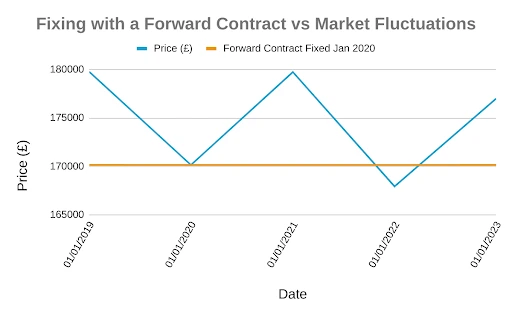
Using a Forward Contract to fix the exchange rate in January 2020 would have secured a comparatively better exchange rate than at most points during 2019-2023. In January 2020, you would have paid £170,145 to acquire €200,000—it would take some two years for that rate to be surpassed in January 2022, when only £167,928 would be needed to buy €200,000.
By speaking with a specialist FX broker that provides Currency Forward Contracts and has a dedicated team of FX currency traders, customers can get a better feel for when to trade and which type of solution to use.
While brokers aren’t able to provide direct advice, they might inform you that the GBPEUR rate in January 2020 or January 2022 has moved to one of its most favourable points in the last five years for individuals looking to buy euros with sterling.
What’s the Cost of a Forward?
The pricing model for Forward Contracts is quite straightforward. Use this Forward Rates Calculator to learn more.
List of All Companies Offering Buying FX Forward Contracts
Below is a comprehensive list of all the companies we have reviewed that provide access to buying Forward Contracts for clients, small businesses, and large corporations. Beyond simply booking a Currency Forward through them, these companies also offer guidance. To execute Forward FX Contracts, you’ll need to speak to a currency dealer directly.
- Currencies Direct Review
- World First Money Transfer Review
- TorFx Review
- Moneycorp Review
- Currency Solutions Review
- Global Reach Review
- OFX Money Transfer Review
- Kantox Money Transfer Review
- Key Currency Money Transfer Review
- Privalgo Money Transfer Review
- Smart Currency Exchange Review
- PureFX Money Transfer Review
- Currencies.co.uk Money Transfer Review
- XE Money Transfer Review (XE.COM)
- Voltrex FX (VFX) Money Transfer Review
- EasyFX Money Transfer Review
- Halo Financial Money Transfer Review
- Afex Money Transfer Review
- AxiaFX Money Transfer Review
- SendFX Review
- Transfermate Money Transfer Review
- Frontierpay Money Transfer Review
- FinGlobal Forex Review
- Fiscal FX Review
Articles you might be interested in:
Discover the potential benefits of dedicated corporate FX services for international transactions. Gain a brief overview of top business FX services and uncover tips for maximizing the advantages of using a corporate foreign exchange specialist.
Learn about the five pillars of a successful currency hedging strategy, explore instruments like forward contracts, limit orders, and stop-loss orders, and discover top companies for hedging currency risk.
Discover how forward contracts allow individuals and businesses to secure exchange rates for future transactions. Delve into the popularity, pros and cons, and common questions surrounding forwards. Gain valuable insight on the best and most accessible specialists for booking forward contracts.
Learn about the process of buying and selling FX options, different hedging strategies, and various types available. Discover recommended platforms for purchasing FX options and learn how they can be used for speculative gains or hedging against currency movements.
Learn about FX swaps, their distinctions from FX forwards, and their suitability for short-term currency solutions. Discover top providers of FX swaps for small and medium-sized businesses.
The benefits and risks of using foreign exchange (FX) limit orders for businesses seeking to hedge their positions in the FX market without venturing into the costlier and more regulated options market. Explore the top brokers for purchasing FX limit orders, learn the distinctions between limit orders and stop-loss orders, and gain insight through real-life examples.
Explore the transformative impact of automation on the payment industry. Fintech startups such as Airwallex and Kantox are at the forefront, offering cost reduction and competitive exchange rates, challenging traditional financial players. As AI advancements replace white-collar professionals, the article examines how payment automation has the potential to revolutionize international commerce.
A comprehensive comparison of the top five online payment gateways for small businesses in the UK. Evaluating factors such as fees, credibility, security, cost, and overall quality, the author presents a detailed analysis of each payment gateway.
With the increasing importance of exchange rates and the rise of ecommerce, SMEs and corporations face heightened risks. The article explores key elements of currency management, such as currency mapping, streamlining accounts through treasury management, and developing an effective FX strategy.
Navigate the complexities of invoicing international clients with this comprehensive guide tailored for UK businesses. We offer practical tips and information to ensure successful invoicing while complying with current legislation and best practices.
Discover the top global payroll services for 2023 in this comprehensive analysis, designed to assist businesses of all sizes with their international hiring and payment needs.
Employer of Record (EOR) services for hiring employees abroad without a local entity. It compares EORs to freelancers/contractors and introduces top providers like Papaya Global, Deel, and Remote.com.
Discover the tax obligations for Australians working overseas, highlighting potential high fees with ATO’s suggested payment methods. The content recommends the efficient, cost-effective OFX for ATO payments from abroad, offering direct debit payments and seamless reconciliation using your PRN, making it an affordable, user-friendly solution for managing overseas tax obligations.