
Currency Forward Contracts: Rates, Providers and Risks
Compare currency brokers that can fix an exchange rate for a future international payment, then check the deposit, term, drawdown and cancellation rules before booking.
Providers with a current forward-contract proposition
These firms combine an established MTC review with current public information about forwards. Eligibility and product terms vary by customer and country.

Currencies Direct
97.8% editorial scoreA service-led provider with business payments, multi-currency collection tools, mass payments, APIs and currency hedging.
Xe
94.5% editorial scoreA global brand with online business transfers, dealer support and forward contracts for eligible corporate customers.

moneycorp
90.2% current MTC scoreA long-established corporate payments group offering international payments, accounts, forwards, orders and wider hedging tools.

OFX
90.4% editorial scoreA listed global provider combining payments, a 30+ currency business account, corporate cards and FX risk tools.

TorFX
93.4% current MTC scoreA broker-led service with business payments, account managers, market information and forward-contract access.

Key Currency
92.8% editorial scoreA smaller UK broker built around direct dealer contact, business payments and tailored currency planning.
Compare established currency providers
Use the live table for the broader company comparison, then ask the shortlisted firms for the exact forward term sheet.


 Currencies Direct: Best Overall for International Money Transfers
- 96% Positive Feedback from Customers, Since 1996
- Service Oriented - Specialising in Large Transfers - Friendly Dealers
- Very Competitive Rates, No Wire Fees

 Xe: The Biggest Name in Currency Since 1993
- Fast and Effective Sign Up Process
- Superb Functionality All Around - Intuitive Online Platform, Smooth App, and Personalised Touch with Dedicated Dealers Above $50,000 Volume
- Global Company with Strong Presence in the UK
 TorFX: Strong Guidance and Staff
- HQ Outside of London - Lower Staff Costs Rolled Over to the Client
- Quick Onboarding Process and Highly Professional
- Trading Desk with 100+ Years of Experience
 moneycorp: Oldest and Most Reputable Foreign Exchange Service
- Providing FX Services since 1979
- Very Recognisable Brand with Excellent Reputation - £36.9bn in Transfers Annually
- Business Specialists

 Key Currency: Well Known Currency Broker with Local Presence UK/Spain
- Fastest Growing UK Currency Transfer Provider
- Strong Onboard Team, Get an Immediate Callback
- Recipient of Multiple Industry Awards

 OFX: The Publicly-Traded Money Transfer Company from Down Under
- Traded Publicly in Australia
- £20bn Turnover per Year
- Ultra Professional
 FC Global Payments: New, Hungry, Driven
- Excellent Client Support
- Industry Experience
- Young and Eager Company with Competitive Rates

 Wise: Low-Cost International Transfer Wizards
- Transparent fees and exchange rates
- Mid-market exchange rates with low fees
- Easy-to-use online platform and app

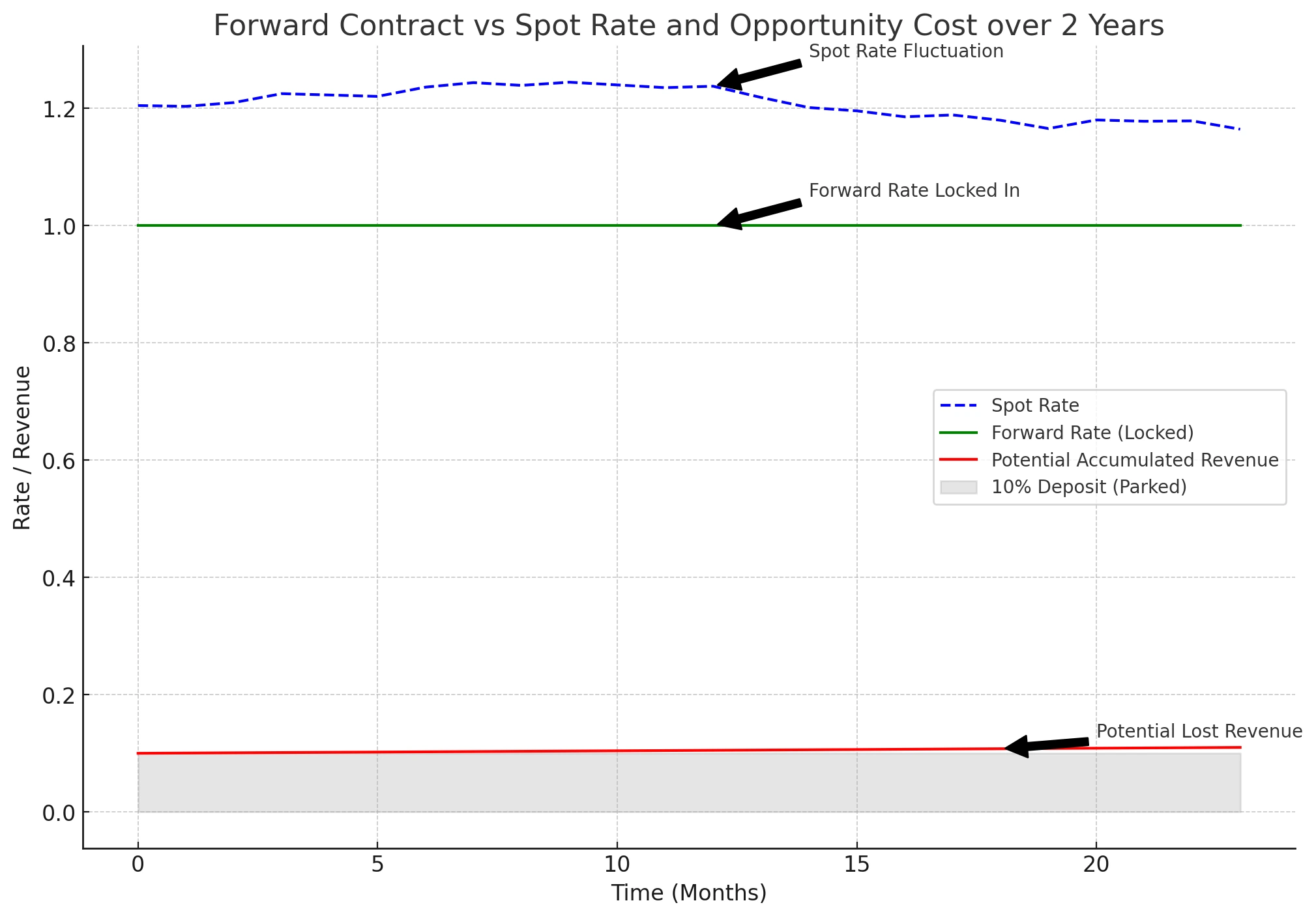
The attraction is simple: know the home-currency cost of a future payment. The contract is less simple. The rate, deposit, delivery window, drawdown rights and close-out calculation all deserve attention.
A forward contract buys budget certainty, not a guaranteed bargain. Compare the forward rate and provider margin, then read what happens if the payment date, amount or underlying transaction changes.
Compare currency brokers that can fix an exchange rate for a future international payment, then check the deposit, term, drawdown and cancellation rules before booking.
How to use this forward-contract comparison
Start with a genuine future payment, then compare matching written terms rather than treating every fixed-rate product as the same.
Currencies Direct, Xe, moneycorp and OFX publish detailed current forward information. TorFX and Key Currency add relationship-led alternatives. Ask two providers to quote the same amount, currency pair, settlement date and delivery structure within a short time window.
The signed facility is more important than the marketing page. It sets the deposit, margin, settlement, extension and close-out rights. Read it before accepting the rate, especially when a property purchase, acquisition or supplier contract can still change.
How a currency forward contract works
The customer agrees an exchange rate, currencies, amount and future settlement date with the provider.
A known invoice, property completion or other future currency need exists.
The currencies, amount, forward rate, value date and facility terms are confirmed.
A deposit may be due at booking, with further margin possible under the agreement.
The customer pays the remaining sold currency and the provider delivers the bought currency.
A spot contract normally settles shortly after it is booked. A forward settles later. Some providers allow fixed or window dates, partial drawdowns or extensions. These features are contractual, not automatic.
The customer does not simply walk away if the market offers a better rate later. The provider may close the contract and charge the resulting loss if the customer cannot settle.
Why the forward rate is not always today's spot rate
Forward pricing reflects the two currencies' interest-rate relationship, contract length and the provider's commercial margin.
Marketing often says “lock in today's rate”. In practice, the quoted forward rate can be above or below the current spot rate. The difference is commonly called forward points. It is influenced by the interest-rate differential between the currencies over the contract period. The provider then applies its pricing.
Suppose a UK importer must buy US$250,000 in six months. At an illustrative forward rate of 1.2500 dollars per pound, the sterling commitment is £200,000. If the future spot rate is 1.1800, buying the dollars then would cost about £211,864. The forward helped the budget by about £11,864. If the future spot rate is 1.3200, the spot purchase would cost about £189,394, but the forward still requires the contracted £200,000.
Ask each provider for the same currency pair, amount, maturity date and drawdown structure at roughly the same time. Compare the contracted home-currency amount and every facility condition.
Current public forward-contract terms
Public pages give a useful starting point. The signed facility agreement controls the actual contract.
| Provider | Advertised term | Public product detail | MTC review |
|---|---|---|---|
| Currencies Direct | Up to two years | Major currencies, flexible delivery and dealing-desk booking | Review |
| Xe Business | Up to 24 months | Contracts beyond 12 months require credit-team approval | Review |
| moneycorp Business | Typically up to two years | Deposit may be required and early closure can cost | Review |
| OFX UK | Up to 12 months | Subject to approval; typical starting point £20,000 | Review |
| TorFX | Quoted to eligible clients | Broker-led product for known future payments | Review |
| Key Currency | Quoted to eligible clients | Relationship-led hedging and currency planning | Review |
A quoted maximum term does not mean every customer receives it. Providers assess the customer, legal entity, currency pair, payment purpose, contract size and credit exposure.
Five risks hidden by the phrase “lock in a rate”
Certainty has value, but the contract can become expensive when the underlying plan changes.
If the market improves, the contracted rate still applies.
Closing after the market moves can crystallise a loss payable by the customer.
Deposits and margin calls can tie up cash before the payment is due.
A late property completion or invoice can fall outside the delivery window.
The business may hedge more currency than the final invoice requires.
The exact contracting entity, safeguarding treatment and agreement matter.
Property buyers should ask what happens if the purchase collapses. Businesses should link each forward to a documented exposure. A general belief that a currency looks attractive is not the same as a payment need.
Currencies Direct states that forward deposits and margin calls are not treated as relevant safeguarded funds until released into the client wallet after settlement. Read the exact provider terms before paying a deposit.
Full, partial and layered forward strategies
The percentage hedged should reflect how certain the payment is.
| Structure | How it works | Main trade-off |
|---|---|---|
| Full hedge | Fix 100% of a known future amount | Highest budget certainty and least ability to benefit from a favourable move |
| Partial hedge | Fix part and leave part for spot conversion | Balances certainty with some market exposure |
| Layered hedge | Book portions at several dates | Reduces one-date timing risk but adds administration |
| Window forward | Set a delivery period rather than one date, where offered | Adds timing flexibility but terms differ |
| Natural hedge | Use foreign-currency income to meet costs in the same currency | Reduces conversion but depends on timing and matching cash flows |
A business might hedge a larger share of signed invoices and a smaller share of uncertain forecasts. A property buyer may wait until legal milestones reduce the risk of cancellation. The right timing comes from the transaction, not a confident market prediction.
What to ask before booking a forward
Request the answers in writing and read the agreement before accepting the rate.
- What legal entity issues the forward contract?
- What is the forward rate and total home-currency commitment?
- How does the quote compare with the provider's spot rate at the same moment?
- What deposit is required and can the provider make margin calls?
- Is settlement on one date or within a delivery window?
- Can the contract be drawn down in parts?
- What happens if the payment date or amount changes?
- How is an early close-out gain or loss calculated?
- Can the provider extend the contract and at what cost?
- What happens if the underlying property purchase or invoice is cancelled?
When a spot transfer, market order or currency account may fit better
A forward solves a specific future-rate problem. Other products solve different problems.
Use a spot transfer when the payment is due now and the current customer rate is acceptable. Use a market order when the payment can wait and the customer wants the trade to execute only if a target rate is reached. A rate alert informs the customer but does not execute. A multi-currency account can hold income in the required currency and create a natural hedge.
Orders can fail to execute. Held balances can create provider and safeguarding exposure. Spot conversion leaves no future protection. Compare the operational risk as well as the market risk.
Best currency brokers
Current recommendations, wider provider map and status audit.
Open guide →Business FX services
Payments, accounts, controls, automation and currency planning.
Open guide →Multi-currency accounts
Hold and receive currencies before deciding when to convert.
Open guide →Built from first-hand industry coverage and current primary sources
Money Transfer Comparison has reviewed international payment companies since 2014. Current legal, regulatory and product claims are linked to the organisations responsible for them.

Alon Rajic
Founder of Money Transfer Comparison, covering providers, pricing and customer use cases since 2014.
Read Alon's profile →
Russell Gous
Former Barclays Corporate Banking professional and senior relationship manager at WorldFirst.
Read Russell's profile →Currency Forward Contracts: Rates, Providers and Risks: common questions
What is a currency forward contract?
It is a binding agreement to exchange a specified amount of one currency for another at an agreed rate on a future date or delivery window.
Does a forward contract lock today's exchange rate?
Not necessarily the exact spot rate. Forward pricing reflects the currency pair, contract term, interest-rate differential and provider margin.
Do I pay for a forward contract upfront?
A provider may require a deposit or approve a credit facility. The remaining balance is due by settlement, and further margin can be required under some agreements.
Can I cancel a forward contract?
A provider may close it, but a market loss can become payable. Cancellation is not the same as walking away without cost.
Can individuals use forward contracts?
Some providers offer them for personal property, emigration or other known payments. Availability, minimum size and jurisdiction rules differ.
Which providers offer forwards for up to two years?
Currencies Direct, Xe Business and moneycorp currently advertise terms up to 24 months or two years, subject to approval and product rules.
What if the exchange rate improves?
The contracted rate still applies. This lost upside is the trade-off for protection against an adverse move.
Is a market order the same as a forward?
No. A market order executes only if a target is reached. A forward fixes a future exchange under a binding contract.
Compare two written forward quotes before fixing the rate
Use the same amount, currencies, settlement date and drawdown structure, then compare the rate, deposit and close-out terms.