
Best Business FX and International Payment Services
Compare business FX providers for supplier payments, foreign income, multi-currency accounts, payroll, mass payments and currency-risk management.
Compare Business FX Specialists


 TorFX: Friendly, Experienced Team with Business Expertise
- Personal, Friendly Service
- High TrustPilot Rating
- Regular Market Updates


 Xe: Advanced Business APIs, Best Streamlined Payments
- Fast and Effective Sign Up Process
- Superb Functionality All Around - Intuitive Online Platform, Smooth App, and Personalised Touch with Dedicated Dealers Above $50,000 Volume
- Global Company with Strong Presence in the UK
 Key Currency: The Best Botique Business FX Broker
- Fastest Growing UK Currency Transfer Provider
- Friendly and Bespoke Currency Guidance
- Extensive Hedging and FX Risk Management Options
 OFX: Best Multi-Currency Account for Businesses
- Traded Publicly on the Australian Stock Exchange
- Superb Multi-Currency Account Offering
- Spotless Reputation for 20 Years
 Moneycorp: Best for Corporations Over $50m/Yr
- Operating Since 1979 - First Commercial FX Firm
- Widest Selection of FX Hedging Tools
- FX Forwards Up to 24 Months
 CurrencyFair: Innovative Online Currency Exchange Platform
- User-friendly Online Platform with Advanced Technology
- Innovative Peer-to-Peer Exchange System
- Transparent Fee Structure with Competitive Rates

Six strong starting points for business foreign exchange
The current business table favours firms that combine competitive transfers with real business support. Platform-led alternatives appear in the wider comparison below.
Xe
94.5% editorial scoreA global brand with online business transfers, dealer support and forward contracts for eligible corporate customers.

Key Currency
92.8% editorial scoreA smaller UK broker built around direct dealer contact, business payments and tailored currency planning.

moneycorp
90.2% current MTC scoreA long-established corporate payments group offering international payments, accounts, forwards, orders and wider hedging tools.

TorFX
93.4% current MTC scoreA broker-led service with business payments, account managers, market information and forward-contract access.

OFX
90.4% editorial scoreA listed global provider combining payments, a 30+ currency business account, corporate cards and FX risk tools.
CurrencyFair
88.2% editorial scoreAn online currency account and transfer platform with a long operating history in Europe and Australia.
A useful provider can collect overseas income, pay suppliers, control team access, reduce repeated conversion and manage committed future currency costs. The strongest choice depends on which of those jobs the business actually needs.
Start with the business task, not the company logo. Xe and Key Currency lead the current business shortlist, moneycorp has the deepest traditional corporate toolkit, OFX joins payments with a 30+ currency account, and platform-led firms suit collections and automation.
Compare business FX providers for supplier payments, foreign income, multi-currency accounts, payroll, mass payments and currency-risk management.
How to use this business FX comparison
Begin with one real payment, then test the account, control and risk-management features that affect the wider finance workflow.
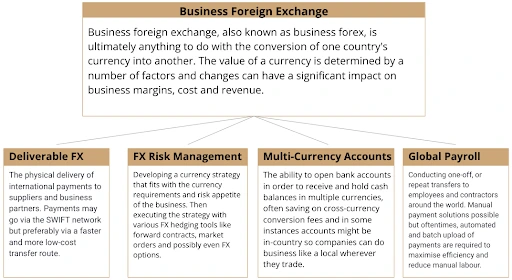
The original page separated business FX into deliverable payments, risk management, multi-currency accounts and global payroll. That structure still works. The market around it has changed. Newer platforms now add cards, expenses, marketplace collection, payment acceptance and APIs, while traditional brokers remain stronger for dealer-led conversion and formal currency planning.
Use the six recommended firms as a commercial shortlist, not as six interchangeable products. Xe and CurrencyFair are strong online routes. Key Currency and TorFX are built around a relationship. moneycorp has a broader corporate risk toolkit. OFX joins transfers to a global account and round-the-clock support. The wider market map adds platforms for receiving, cards, marketplace income and automation.
Six jobs sold under the business FX label
One provider can cover several jobs, but very few are strongest at all of them.
Convert currency and deliver invoices by local rails or SWIFT, with the right reference and fee instruction.
Receive customer or marketplace income into local or multi-currency account details before conversion.
Use forwards, market orders or a written hedging policy for committed future exposure.
Upload or automate many payments to contractors, employees, sellers or beneficiaries.
Issue controlled physical or virtual cards and reconcile foreign spending in one account.
Connect payment creation, approvals, reporting and reconciliation to internal systems.
OFX, Wise, Airwallex, WorldFirst and other payment platforms describe account products with different legal structures. Check local details, third-party receipt rules, safeguarding and whether direct debits or cards are supported.
Business FX providers by operating model
The archive covers 47 companies. This shorter current map separates providers that solve different business problems.
| Provider | Main model | Notable capability | Best starting use |
|---|---|---|---|
| Xe | Hybrid transfer provider | Online transfers, dealers and business forwards | Broad international payment needs |
| Key Currency | Boutique broker | Direct dealer support and hedging | Owner-managed companies |
| moneycorp | Corporate payments and FX | Accounts, mass payments, forwards and wider risk tools | Treasury and repeat exposure |
| TorFX | Relationship-led broker | Business payments and forward contracts | SMEs wanting a named contact |
| OFX | Global payments platform | 30+ currency account, cards, transfers and FX tools | Global operations and support |
| CurrencyFair | Online FX account | Self-service transfers and held currencies | Straightforward online conversion |
| Currencies Direct | Broker plus platform | Managers, accounts, mass payments, APIs and hedging | Managed business payments |
| WorldFirst | Business collection account | 20+ receiving currencies and 100+ payment currencies | Marketplaces and online sellers |
| Airwallex | Global finance platform | Accounts, payments, cards, expenses, checkout and APIs | Technology-led global finance |
| Wise Business | Digital account and transfers | 40+ held currencies and batch payments | Transparent self-service flows |
| Payoneer | Marketplace payments | Platform income, local receiving details and payouts | Freelancers and marketplaces |
| Corpay | Corporate cross-border group | Payments, risk tools and multi-currency accounts | Larger corporate programmes |
| Alpha Group | Corporate financial solutions | Institutional and corporate FX focus | Larger businesses |
| Kantox | Currency-management software | Automated exposure and hedging workflows | Mid-market finance teams |
| IFX Payments | Corporate payments firm | Payments and multi-currency account services | Business-only comparison |
| Lumon | Currency broker | Dealer-led business and personal payments | Service-led alternatives |
The long review archive still matters, but it should not be mistaken for a current endorsement list. Use the complete provider review directory for historical and smaller firms, then return to this page for the current business shortlists.
Old business FX names need current treatment
Acquisitions and failures can turn a familiar review into brand history.
Halo Financial Limited is in administration. Its review belongs in the archive, not in a current business shortlist.
Both histories now sit within Corpay Cross-Border. They should not appear as three unrelated current choices.
CurrencyUK was acquired by Currencies Direct. The old review remains useful, but the current decision sits with the parent service.
Business accounts now play a larger role beside traditional brokerage. Compare account rails and controls separately from the FX quote.
A provider can remain in the review archive without appearing in the current recommendations. Historical coverage records the market; the shortlist is a present-day commercial decision.
Calculate business FX cost against the invoice, not the fee label
A no-fee payment can still carry a wide exchange-rate margin.
For a £100,000 supplier payment, a 1.80% currency margin represents about £1,800 before any bank deduction. A provider charging a visible £40 fee and a 0.45% margin would cost about £490. The second quote is cheaper by roughly £1,310 even though its fee line is higher.
Record annual volume and quote the same payment to two providers. Negotiated pricing often improves with repeat volume. Recheck it at least periodically. A sharp first trade does not prove that later margins will stay sharp.
The international transfer fee guide shows how to combine fixed charges, rate margins and possible bank deductions.
Build a business payment workflow before choosing software
The provider should fit the controls, not force the business to abandon them.
List currencies, amounts, dates, confidence levels and natural offsets.
Define who creates, approves, releases and reconciles each payment.
Run the same payment through two services and inspect the full payout.
Track margin, failure rate, timing, support and reconciliation work.
- Ask whether one user can both create and approve a payment.
- Confirm beneficiary whitelisting and change alerts.
- Test batch-file validation before payroll day.
- Check API authentication, idempotency and failure reporting.
- Match payment references to invoices and ledger entries.
- Keep a second provider ready for operational resilience.
Use hedging for known exposure, not market betting
A business policy should start with invoices and cash flow rather than a dealer's market view.
A business importing in dollars and earning in pounds has a real exposure when a supplier invoice is committed. It can convert immediately, leave the exposure open, fix some or all of the future rate, or spread trades across dates. Each choice affects certainty and opportunity.
A currency forward contract can fix the exchange rate for a future payment. It also creates an obligation. Ask about deposits, margin calls, drawdowns, extensions and cancellation before signing. A target order is different because it executes only if a chosen rate is reached and may leave the payment unhedged.
State which exposures qualify, what proportion can be hedged, who can approve a trade, permitted providers and how results are reported. The policy matters more than a forecast.
Questions to ask every business FX provider
A strong sales call should produce specific written answers.
- Which legal entity will contract with the business?
- Which currencies and countries can it send to and receive from?
- Are local account details held in the business's name?
- What is the quoted margin at expected annual volume?
- Are there account, payment, card, receipt or inactivity fees?
- Which forward products are available and what credit facility is required?
- Can payments use dual approval, roles and beneficiary controls?
- Are batch files, APIs and accounting integrations included?
- What happens when a payment fails after conversion?
- How are safeguarded funds and forward deposits treated?
Built from first-hand industry coverage and current primary sources
Money Transfer Comparison has reviewed international payment companies since 2014. Current legal, regulatory and product claims are linked to the organisations responsible for them.

Alon Rajic
Founder of Money Transfer Comparison, covering providers, pricing and customer use cases since 2014.
Read Alon's profile →
Russell Gous
Former Barclays Corporate Banking professional and senior relationship manager at WorldFirst.
Read Russell's profile →Best Business FX and International Payment Services: common questions
Which business FX company is best?
Xe leads the current MTC business shortlist. moneycorp has strong corporate and hedging depth, OFX combines payments with a 30+ currency account, and smaller brokers can offer a more personal relationship.
Can a small company use a corporate FX provider?
Yes. Many providers accept SMEs and owner-managed businesses, although account eligibility, minimum volumes and hedging access differ.
Is a multi-currency account a bank account?
Not always. Many are payment or e-money accounts. Check the legal entity, local account details, safeguarding and accepted payment types.
How much can a business save against a bank?
There is no fixed saving. Compare one live invoice using the final recipient amount. The percentage difference becomes more valuable as transfer size rises.
Should a business use one or two FX providers?
Two active providers can improve price discipline and operational resilience. More accounts can add compliance and reconciliation work.
Can business FX services automate payroll?
Some support batch files, mass payments or APIs. They are payment tools, not full employer-of-record or payroll-tax services.
Are forward contracts suitable for every company?
No. They suit known future exposure and create an obligation. Availability, credit approval, deposit terms and cancellation costs differ.
What happened to Halo Financial?
Halo Financial Limited is in administration, so it is not presented as a current business FX option.
Quote one real business payment across the right provider types
Match the account, control and hedging needs first, then compare the final recipient amount for the same invoice.